
Laser treatment for hemorrhoids can be performed under local anesthesia. The procedure utilizes a radial optical fiber to precisely deliver laser energy into the core of the hemorrhoid, achieving ablation from the inside out. This technique acts with high selectivity upon the pathological tissue while preserving the integrity of the surrounding mucosa and sphincter structures. Its therapeutic mechanism involves two key principles: first, severing the blood supply to the abnormally enlarged hemorrhoid to induce ischemia and subsequent atrophy; and second, triggering tissue contraction through a photothermal effect to induce necrosis of the hemorrhoidal venous plexus epithelium, thereby achieving the complete elimination of the hemorrhoid.
What is the difference between laser hemorrhoid surgery and traditional surgery?
The advantage of using lasers compared to traditional surgery is that the fibrotic reconstruction will produce new connective tissue, ensuring the adhesion of the mucosa to the underlying tissue. This can also prevent the occurrence or recurrence of prolapse.
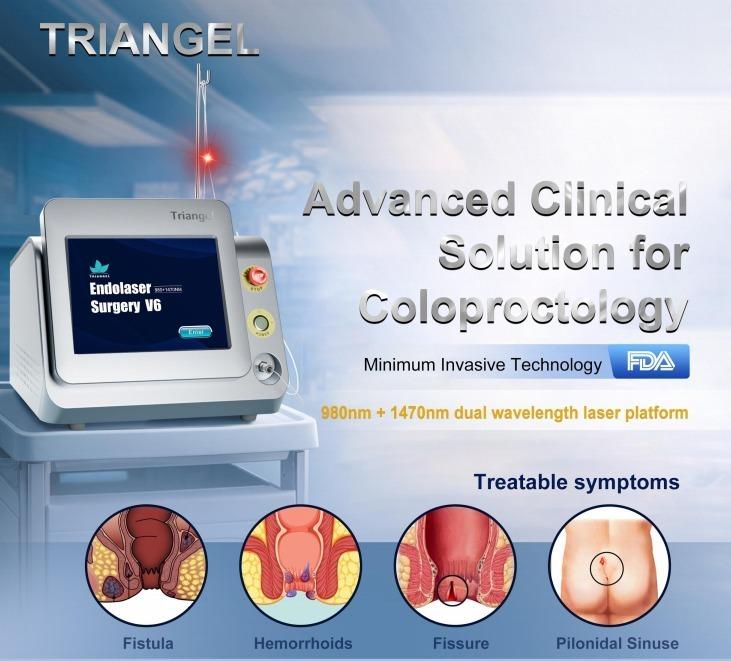
why choose 980nm+1470nm ?
1. 980nm Laser (Focus: Coagulation/Hemostasis):
This wavelength is readily absorbed by hemoglobin in the blood. Its primary function is to occlude the arteries supplying blood to the hemorrhoid, causing the hemorrhoid to undergo necrosis and atrophy due to ischemia, while simultaneously providing excellent hemostatic effects.
2. 1470nm Laser (Focus: Contraction/Vaporization):
This wavelength is readily absorbed by the water content within tissues. Its primary function is to induce the denaturation of collagen within the hemorrhoidal tissue, causing the tissue to immediately shrink and contract in volume, while also serving to anchor prolapsed mucosa in place.
Applications of Laser Treatment in Proctology
*Piles/Hemorrhoids, laser hemorrhoidectomy
*Fistula
*Fissure
*Pilonidal Sinus /Cyst
Post time: Apr-29-2026